For architect-scenographer Alain Moatti, a successful office building fosters encounters to «get to know people». A vision that, in his opinion, defines beauty and the French Touch.
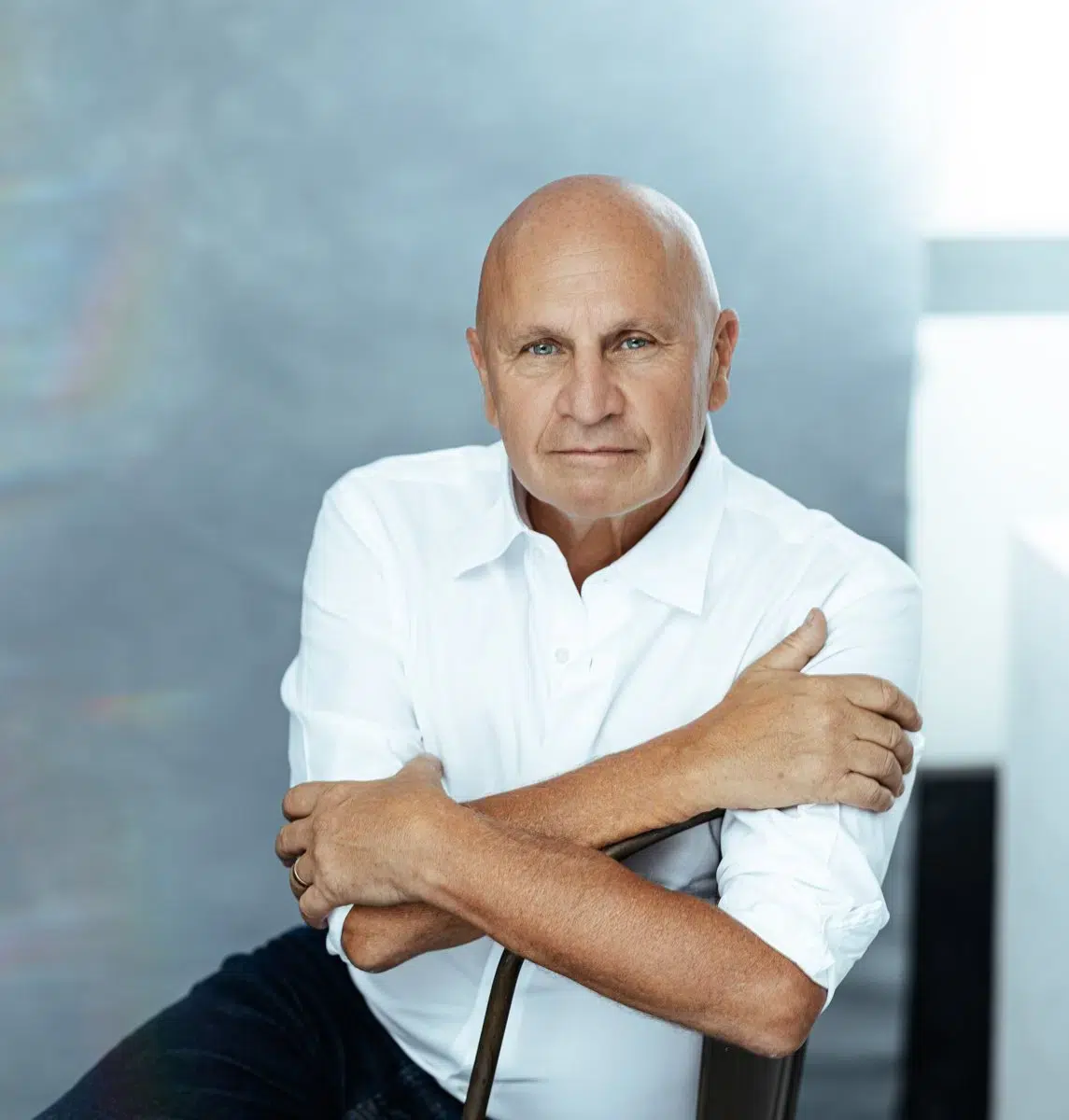
Alain MOATTI
Architect-scenographer, founder of the Moatti & Rivière studio
You are an architect and a scenographer. How does this approach transform your way of designing an office?
I define scenography as the art of storytelling. Thus, when it involves working on the installation of ancient works in a museum, I always wonder why they were preserved. I aim to convey what they still have to tell us today, in order to create a dialogue between the cultures of the past and our contemporary era. For an office, the problem is actually quite similar. It must offer comfort and efficiency to those who work there: that is the functional aspect. It must also create a unique, defined space, drawn by history, culture, identity, and the project of the company that settles there: that is the symbolic aspect. This identity must be inscribed through a unique narrative in the architecture so that each of the employees can feel it and share it. That is what «makes a company.» A successful office building is the place where the meeting between this corporate identity, made tangible through architecture, and those who will live there takes place. This meeting creates the social cohesion of a group. Successful architecture creates this bond.
Why has this search for meeting someone become so important today?
Our sensory lives have been profoundly transformed by digital technology and smartphones, which have blended our love lives, professional lives, family life, intimate relationships… But these digital interactions produce immense loneliness: what I call the «strength of weak relationships.» What architecture makes possible is the opposite: creating strong relationships: shared stories, rooted places, encounters and face-to-face dialogues. Architecture is a «relational amplifier.» Moreover, two words characterize our era: simultaneity and immediacy. We want to be able to work, eat, love, play sports, exchange, and have fun, sometimes in the same place and almost at the same time. This evolution necessarily transforms buildings to meet contemporary lives.
My research consists of making each building a small urban space, where uses intersect and enrich each other rather than simply juxtapose. This requires accepting the need to leave some space for unassigned areas. Real estate professionals abhor the void, which they consider wasted square meters, when in fact it is precisely these unprogrammed spaces that allow for the most rich uses. Assigned to no particular purpose, they can accommodate different gatherings and activities to be invented.
In Pantin, for Alios Développement, we are designing the project for the Halle des Grandes-Serres, where we are developing 14 different programs around a large 2,500 m² space. This space becomes an area of attraction, breathing life into the surroundings and creating encounters with multiple uses. It is the one that multiplies the creation of value from the asset.
How does this search for strong relationships translate into practice in the project you are leading, for example at One Monceau for EY?
The One Monceau project stems from my fundamental question: in an office building, how can «the company» be created with all the partners, collaborators and interns? The company must be able to express a strong, unique identity in which everyone can identify themselves. In the First Tower in La Défense, EY employees worked three days a week remotely. Upon their return to Paris, we observed a very strong desire to find a collective place to meet. The challenge is therefore to design places where partners and collaborators can gather, exchange and contribute to a common culture.
An office building should not impose fixed usage patterns. It should also leave room for those who inhabit it, with spaces without definitive functions capable of accommodating the unexpected.
At One Monceau, on the ground floor, a long street of 120 m by 12 m with multiple uses connects all the spaces together. These transition spaces, often considered purely utilitarian, become magnified here: symbolically, they connect all the employees together, dressed in a material developed specifically for EY, the «Black Light», inspired by the artist Pierre Soulages.
« With the return to the office, we observe a very strong desire to find a collective place.»
Alain Moatti
You associate French Touch with beauty. But what makes this beauty possible?
I prefer the «French savoir-faire» or the «French talent» to French Touch.
At the Hôtel de la Marine, on Place de la Concorde, which I restored, the salons used to open once a month under Louis XVI to showcase the furniture commissioned by the king and queen. All of Europe came to discover the innovative craftsmanship and French aesthetic of the 18th century.e century.
What is beauty today? It’s no longer an aesthetic standard. For me, it’s the quality of the encounter found in this digital world: through a phrase, a landscape, a painting, an architecture, with another human being. This encounter brings us back to life, to question.
As an architect, the first meeting is the place where one builds: understanding what happened there, taking history into action and extending it, relying on this context as the basis for creativity. It is to think that one does not live in the functional or the structural, but in the imaginary and the symbolic. Therefore, the human principle is the first principle. It is opposing the hold of modernism in architecture that has become nothing more than an outdated formal language. The «French talent» is therefore to invent narrative architecture. It is to invent a unique place through narration.
The beauty of architecture therefore does not lie solely in its form or aesthetics. It stems from the quality of the encounters it enables between users, the connections it creates between them. It is also the only way to ensure that architecture belongs to everyone. These places of encounter and dialogue are possible thanks to freedom. Without freedom of speech, without freedom to be oneself, there is no true encounter or dialogue.
In my agency, many of my employees come from abroad, and many have chosen to come and work in France because of this freedom of speech, this freedom of expression that they did not find elsewhere. This freedom is precious.
Regarding your workplace and its neighborhood, would you say that you are satisfied with the various elements?
Expats
French
69 %
65 %
60 %
55 %
60 %
56 %
If a majority of French people are satisfied (more than 50 %%), expats are systematically more satisfied than their Parisian counterparts when it comes to green spaces, access to monuments and heritage buildings, or the view from their office.
The «hit-parade» of the expatriates' favorite neighborhoods
Do you have a good idea of these districts of Paris where you could work?
Answers from expats
-
1. Louvre / Palais Royal
93 %
-
2. Quartier Latin
90 %
-
3. Saint-Germain-des-Prés
86 %
-
4. The Marais
80 %
-
5. Batignolles
79 %
-
6. Canal Saint-Martin
78 %
-
7. Passy / Trocadéro
77 %
-
8. Bastille
73 %
-
9. Republic / Oberkampf
73 %
-
10. Montmartre
72 %
-
11. Champs-Élysées / Golden Triangle
72 %
-
12. Ménilmontant
67 %
-
13. Bercy
65 %
-
14. Belleville
60 %
-
15. Pigalle / South Pigalle
51 %
The postcard of the capital has not seen a single scratch. The emblematic districts of Paris act as a magnet, for tourists, of course, but also for those who decide to come and make their lives in Paris.